
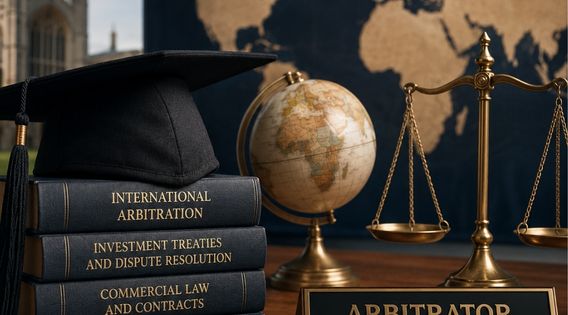
As cross-border disputes grow more technically demanding, parties and institutions are increasingly asking a question that arbitration practice rarely addressed directly a decade ago: does an arbitrator’s academic training actually matter once a case reaches the tribunal room?
The International Arbitrator, a triple-qualified international arbitrator admitted in New York, Washington, D.C., England & Wales and India, and known across his practice as a Cambridge educated arbitrator in India, draws the answer from direct experience rather than theory. He holds a Master of Arts in Law from the University of Cambridge, awarded with a specialization in commercial law, followed by an LL.M. in International Dispute Resolution and Arbitration from Georgetown University Law Center, completed with Distinction. That academic foundation was followed by a Special Legal Consultant role at the International Centre for Settlement of Investment Disputes at the World Bank Group, and case-level practice at Three Crowns LLP, Dechert LLP and Wiley Rein LLP on disputes exceeding USD 5.4 billion in aggregate value.
The question of academic pedigree is not incidental in today’s arbitration market. Modern disputes routinely combine several bodies of law within a single proceeding, requiring fluency in treaty interpretation, sector-specific regulation and the procedural rules of two or three institutions at once. A Cambridge-trained arbitrator’s grounding in comparative legal method translates directly into reasoned, defensible awards that withstand annulment and enforcement challenges, particularly where courts scrutinize the tribunal’s legal reasoning closely.
This is most visible in three areas of practice. In energy disputes, where a single case can turn on the interaction between a power purchase agreement, domestic regulatory measures and an overlapping investment treaty, the ability to move fluently between contract, statute and treaty is exactly what a specialized energy dispute arbitrator draws on daily. Sovereign and investor-state matters raise the stakes further: a sovereign dispute arbitrator hearing a claim against a state must apply principles such as fair and equitable treatment or expropriation with the rigor a Cambridge legal education instils. Technology and IP disputes present a newer but equally demanding challenge, where a technology, IP & domain name dispute arbitrator must apply licensing law, ICANN and UDRP frameworks and cross-border IP doctrine within tight timelines, work that rewards the same academic discipline.
“Academic training does not replace practical experience, but it shapes how an arbitrator approaches an unfamiliar body of law under time pressure,” he observed. “Complex international disputes rarely fit neatly within a single legal framework, and the ability to reason across systems is something legal education builds long before the first appointment.”
With an established practice spanning India, the United States, the United Kingdom and beyond, his combination of academic credentials and institutional experience continues to inform his approach to the technically complex, multi-jurisdictional disputes that increasingly define international arbitration. The International Arbitrator is currently accepting appointments as sole arbitrator, tribunal member and mediator across commercial, energy, sovereign and technology-sector disputes worldwide.

